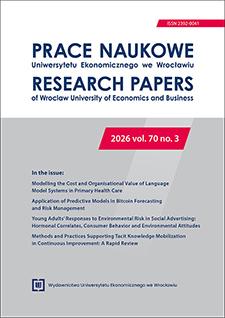
Modelling the Cost and Organisational Value of Language Model Systems in Primary Healthcare
DOI:
https://doi.org/10.15611/pn.2026.3.02Keywords:
large language models (LLM), token consumption, cost modelling, organisational decision support, primary health careAbstract
Aim: This study aimed to examine the economic and organisational implications of a prototype system based on a large language model (LLM), designed to structure initial patient interview data in Polish primary healthcare.
Methodology: The exploratory study adopted a mixed-method approach, combining token consumption analysis across ten predefined patient scenarios with a semi-structured expert interview.
Results: The quantitative results demonstrated the stability and predictability of token usage, enabling preliminary modelling of computational costs under controlled conditions. The qualitative findings indicated potential organisational usefulness of the system, particularly in supporting information structuring prior to consultations.
Implications and recommendations: The findings suggest that language model-based solutions may support primary care processes in a cost-aware manner, provided that appropriate data protection measures and professional oversight are ensured. Further research should focus on real-world implementation, more diverse patient data, and extended system functionalities.
Originality/value: This study contributes to the literature by linking computational cost analysis with perceived organisational value in the context of primary healthcare, with a particular focus on the initial stage of the medical interview, which remains underexplored.
Downloads
References
Adamopoulou, E., & Moussiades, L. (2020). Chatbots: History, Technology, and Applications. Machine Learning with Applications, 2, 100006. https://doi.org/10.1016/J.Mlwa.2020.100006
Asan, O., Bayrak, A., & Choudhury, A. (2020). Artificial Intelligence and Human Trust in Healthcare: Focus on Clinicians. Journal of Medical Internet Research, 22(6), e15154. https://doi.org/10.2196/15154
Bommasani, R., Hudson, D. A., Adeli, E., Altman, R., Arora, S., Arx, S. von, Bernstein, M. S., Bohg, J., Bosselut, A., Brunskill, E., Brynjolfsson, E., Buch, S., Card, D., Castellon, R., Chatterji, N., Chen, A., Creel, K., Davis, J. Q., Demszky, D., … Liang, P. (2022). On the Opportunities and Risks of Foundation Models. arXiv:2108.07258. https://doi.org/10.48550/arXiv.2108.07258
Chui, M., Hazan, E., Roberts, R., Singla, A., Smaje, K., Sukharevsky, A., Yee, L., & Zemmel, R. (2023). The Economic Potential of Generative AI. The Next Productivity Frontier. McKinsey & Company. Retrieved April 3, 2026, from https://www.mckinsey.com/~/media/mckinsey/business%20functions/mckinsey%20digital/our%20insights/the%20economic%20potential%20of%20generative%20ai%20the%20next%20productivity%20frontier/the-economic-potential-of-generative-ai-the-next-productivity-frontier.pdf
Davenport, T. H., & Ronanki, R. (2018). Artificial Intelligence for the Real World. Harvard Business Review.
Esteva, A., Kuprel, B., Novoa, R. A., Ko, J., Swetter, S. M., Blau, H. M., & Thrun, S. (2017). Dermatologist-Level Classification of Skin Cancer with Deep Neural Networks. Nature, 542(7639), 115-118. https://doi.org/10.1038/nature21056
Gholipour, M., Khajouei, R., Amiri, P., Gohari, S. H., & Ahmadian, L. (2023). Extracting Cancer Concepts from Clinical Notes Using Natural Language Processing: A Systematic Review. BMC Bioinformatics, 24, 405. https://doi.org/10.1186/s12859-023-05480-0
İşgüzar, S., Fendoğlu, E., & Şimşek, A. I. (2024). Innovative Applications in Businesses: An Evaluation on Generative Artificial Intelligence. Amfiteatru Economic, 26(66), 511-530. https://doi.org/10.24818/EA/2024/66/511
Jiang, F., Jiang, Y., Zhi, H., Dong, Y., Li, H., Ma, S., Wang, Y., Dong, Q., Shen, H., & Wang, Y. (2017). Artificial Intelligence in Healthcare: Past, Present and Future. Stroke and Vascular Neurology, 2(4). https://doi.org/10.1136/svn-2017-000101
Kellermann, A. L., & Jones, S. S. (2013). What It Will Take to Achieve the As-Yet-Unfulfilled Promises of Health Information Technology. Health Affairs, 32(1). https://doi.org/10.1377/hlthaff.2012.0693
Kermany, D. S., Goldbaum, M., Cai, W., Valentim, C. C. S., Liang, H., Baxter, S. L., McKeown, A., Yang, G., Wu, X., Yan, F., Dong, J., Prasadha, M. K., Pei, J., Ting, M. Y. L., Zhu, J., Li, C., Hewett, S., Dong, J., Ziyar, I., … Zhang, K. (2018). Identifying Medical Diagnoses and Treatable Diseases by Image-Based Deep Learning. Cell, 172(5), 1122-1131, e9. https://doi.org/10.1016/j.cell.2018.02.010
Mohapatra, B., Mohapatra, S., & Mohapatra, S. (2023). Process Automation Strategy in Services, Manufacturing and Construction (chapter 2: Business Process Automation). Emerald Publishing Limited. https://doi.org/10.1108/978-1-80455-143-120231004
Możarowski, W., Mateńko, J., Krupa, A., Kiełbratowska, J., Mozer, M., Potrykus, M., Pałuchowski, M., Pietruszka, W., Klasicki, P., & Krawczyk, A. (2025). Rola, cele i perspektywy rozwoju innowacji oraz nowych technologii cyfrowych w praktyce lekarza medycyny rodzinnej w Polsce. Forum Medycyny Rodzinnej, 19(3), 121-130. https://doi.org/10.5603/fmr.104779
Narodowy Fundusz Zdrowia. (2013). Zarządzenie Nr 69/2013/DSOZ Prezesa Narodowego Funduszu Zdrowia z dnia 27 grudnia 2013 r. w sprawie określenia warunków zawierania i realizacji umów o udzielanie świadczeń opieki zdrowotnej w rodzaju podstawowa opieka zdrowotna. Retrieved April 3, 2026, from https://www.nfz.gov.pl/zarzadzenia-prezesa/zarzadzenia-prezesa-nfz/zarzadzenie-nr-692013dsoz,5800.html
OECD & European Observatory on Health Systems and Policies. (2024). Polska: Profil systemu ochrony zdrowia 2023. OECD Publishing. https://doi.org/10.1787/b12d3d03-pl
OpenAI Developers. (n.d.). Pricing. Retrieved April 3, 2026, from https://developers.openai.com/api/docs/pricing/
Poon, E. G., Lemak, C. H., Rojas, J. C., Guptill, J., & Classen, D. (2025). Adoption of Artificial Intelligence in Healthcare: Survey of Health System Priorities, Successes, and Challenges. Journal of the American Medical Informatics Association, 32(7), 1093-1100. https://doi.org/10.1093/jamia/ocaf065
Raghupathi, W., & Raghupathi, V. (2014). Big Data Analytics in Healthcare: Promise and Potential. Health Information Science and Systems, 2(1), 3. https://doi.org/10.1186/2047-2501-2-3
Sarker, I. H. (2022). AI-Based Modelling: Techniques, Applications and Research Issues Towards Automation, Intelligent and Smart Systems. SN Computer Science, 3(2), 158. https://doi.org/10.1007/s42979-022-01043-x
Sasseville, M., Yousefi, F., Ouellet, S., Naye, F., Stefan, T., Carnovale, V., Bergeron, F., Ling, L., Gheorghiu, B., Hagens, S., Gareau-Lajoie, S., & LeBlanc, A. (2025). The Impact of AI Scribes on Streamlining Clinical Documentation: A Systematic Review. Healthcare, 13(12), 1447. https://doi.org/10.3390/healthcare13121447
Suska, E. (2025). Sztuczna inteligencja w medycynie. Pedagogika Społeczna, (3), 83-90. https://doi.org/10.35464/1642-672X.PS.2025.3.08
Tabassi, E. (2023). Artificial Intelligence Risk Management Framework (AI RMF 1.0). National Institute of Standards and Technology (U.S.). https://doi.org/10.6028/NIST.AI.100-1
Topol, E. J. (2019). High-Performance Medicine: The Convergence of Human and Artificial Intelligence. Nature Medicine, 25(1), 44-56. https://doi.org/10.1038/s41591-018-0300-7
Zhao, W., Zhou, K., Li, J., Tang, T., Wang, X., Hou, Y., Min, Y., Zhang, B., Zhang, J., Dong, Z., Du, Y., Yang, C., Chen, Y., Chen, Z., Jiang, J., Ren, R., Li, Y., Tang, X., Liu, Z., Liu, P., Nie, J.-Y., & Wen, J.-R. (2026). A Survey of Large Language Models. Frontiers of Computer Science, 20. https://doi.org/10.1007/s11704-026-60308-3
Downloads
Published
License
Copyright (c) 2026 Julia Trzaska

This work is licensed under a Creative Commons Attribution-ShareAlike 4.0 International License.
Accepted 2026-07-08
Published 2026-10-07